Proved alive, not just listed
We open a real OpenVPN control-channel handshake against every server every five minutes. Not a ping, not a port scan — the same conversation your client would start.
Every server on this page answered a real OpenVPN handshake in the last five minutes — the full probe history sits on each server's page. Download the .ovpn and open it in any OpenVPN client. No signup, no email.
We open a real OpenVPN control-channel handshake against every server every five minutes. Not a ping, not a port scan — the same conversation your client would start.
50% reliability, 35% median latency, 15% how it is doing right now — then a discount for UDP on a high port, which mobile carriers like to drop. The formula is public and the history behind every number is on the server's own page.
Download the .ovpn straight from the browser and open it in OpenVPN Connect, OpenVPN GUI or Tunnelblick. No account, no email.
Every country with a server answering right now — the best 5 of each. Full lists live on the country pages.
We track 7,689 servers in total. 1,525 of them answered a real OpenVPN handshake in the last five minutes, across 45 countries. That check is not an ICMP ping: the prober opens the OpenVPN control channel exactly as your client would, and a server counts as alive only when it answers. Where the control channel is encrypted end to end the handshake is out of reach, and those fall back to a plain connection check — weaker evidence, and we say which check ran. Every server is probed on the same five-minute cycle, and the last round finished 1m ago.
Coverage follows what volunteers publish rather than any plan of ours. Japan alone accounts for 706 of the live servers, and the three busiest countries hold 1,324 of the 1,525 between them. At the other end, 20 countries are represented by a single machine each — worth knowing before you plan around one of them. The country index has the whole distribution.
The quickest live server replied in 4 ms, against a fleet average of 64 ms. Those are measured from our prober, which sits in one fixed place: they rank servers against each other honestly, but neither is a prediction of your own ping — if you are closer to a server than the prober is, yours will be lower. A completed handshake proves that an OpenVPN daemon is listening and willing to talk. It asserts nothing about that machine's own bandwidth, and nothing about who runs it or what they can see.
Every server is ranked by one score: 50% measured reliability, 35% median latency and 15% how the server is doing this hour. None of these machines is operated by this site — they are volunteer servers, published by their operators and withdrawn without notice, which is why the list is collected again every hour — the last collection round finished 1m ago — and re-ranked after every probe round. How it works sets out the pipeline and the formula in full.
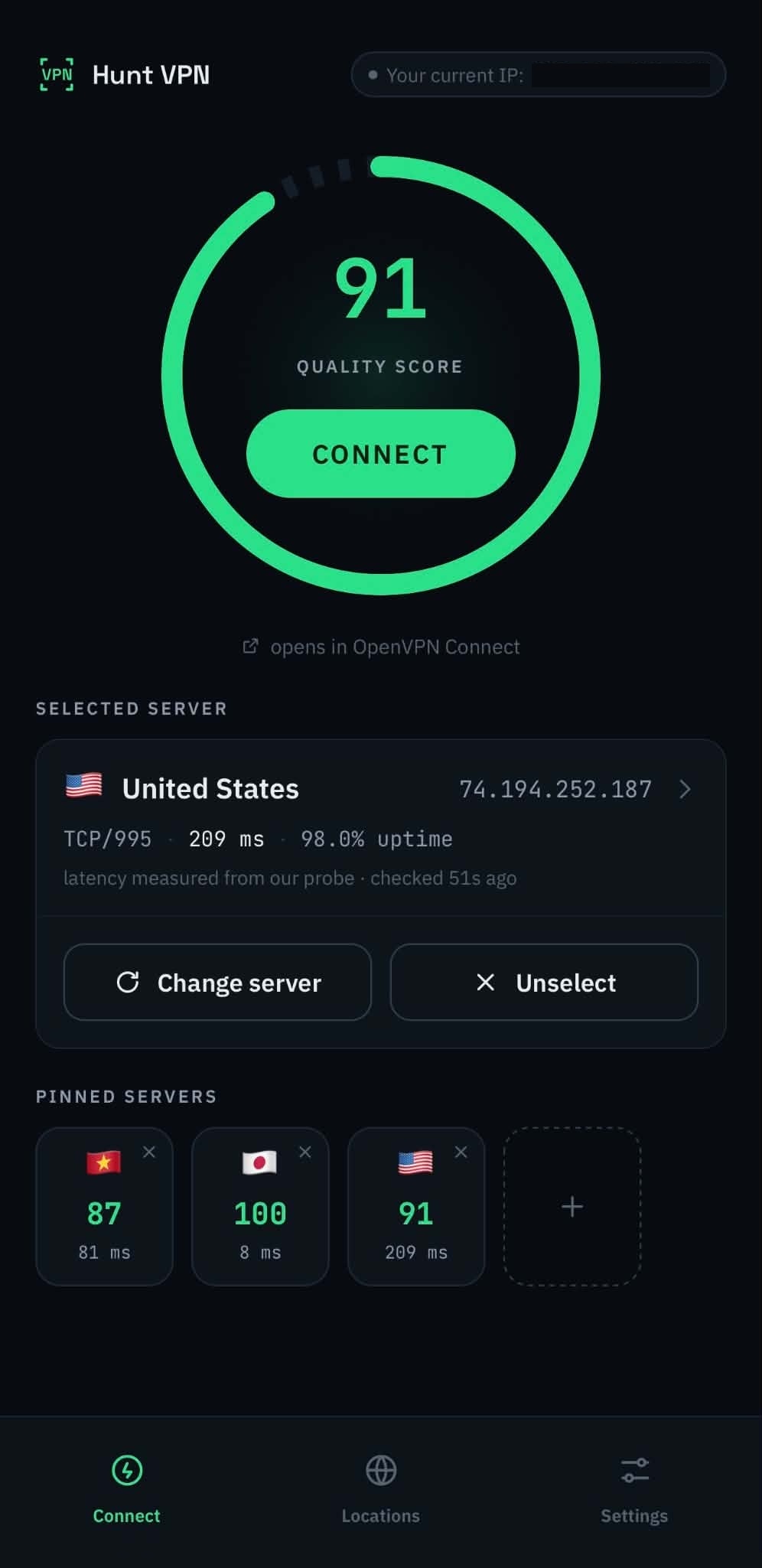
Same list, same scores — plus one-tap handoff straight into OpenVPN Connect, so you never touch a file manager on mobile.
Android is a preview build you install from an apk file. iOS is still in build.